EBC Webstore
Eastern Book Company

|
|||
|
|||

 Home > LAW BOOKS > Taxation Laws > Goods and Service Tax Home > LAW BOOKS > Taxation Laws > Goods and Service Tax |



 5
5
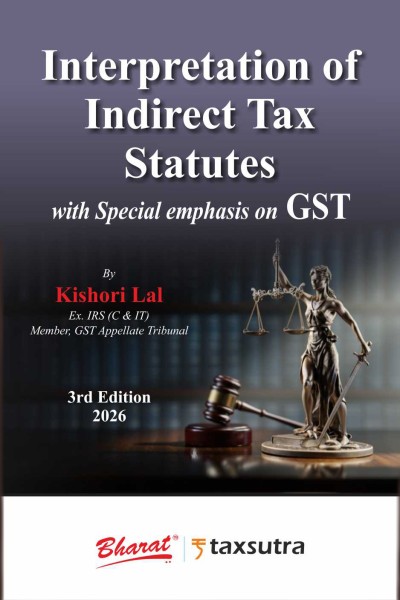
This book provides a comprehensive, analytical, and practice-oriented exposition of the principles governing interpretation of indirect tax statutes, with a focused emphasis on GST. It offers clarity on classical and modern interpretative rules, judicial doctrines, procedural concepts, valuation principles, exemption mechanics, and appellate frameworks that shape the indirect tax ecosystem in India. Structured meticulously across 43 chapters, it equips readers to understand not just the letter of the law but the reasoning, philosophy, and judicial logic that guide its application. The work is an essential bridge between theory and practice, empowering professionals to navigate complex statutory provisions with confidence and precision.
Key Features
This book is invaluable for GST and indirect tax practitioners, advocates, chartered accountants, IRS officers, departmental officials, corporate tax managers, and academicians seeking a deeper understanding of statutory interpretation in indirect tax law. Students of taxation and professionals preparing for competitive or departmental examinations will find it an authoritative source for both conceptual clarity and practical application. Courts, tribunals, and advisory firms can also rely on this resource for structured interpretation and litigation strategy.
![INDIRECT TAX LAWS [(GST, Customs & FTP) All in One Compact + Charts + Compiler]](https://s3.amazonaws.com/ebcwebstore/images/978-93-86921-16-1.jpg)


|

Click on TITLE to choose available options.
|

|
Click on TITLE to choose available options.
|
![The Practical Lawyer - PLW [Annual Subscription]](https://s3.amazonaws.com/ebcwebstore/images/the-practical-lawyer-magazine-annual-subscription.png)
|
Click on TITLE to choose available options.
|

|
Click on TITLE to choose available options.
|

|
Click on TITLE to choose available options.
|

|
Click on TITLE to choose available options.
|

|
|

|
Click on TITLE to choose available options.
|

|
Click on TITLE to choose available options.
|
|
|
|
||
|
||
|