Want a Shipping Estimate? Add an Indian Pin Code, Click Here
This Product
Ships in 3-4 Weeks
Recommend
1
Share
4
Share
2
Share
5
Share
1
Send By e-mail
Verify Phone Number
Please enter the One Time Password (OTP) to verify phone number.
Write your own review
In just a few steps below you can become an online reviewer.
Please click on Continue to submit your review.
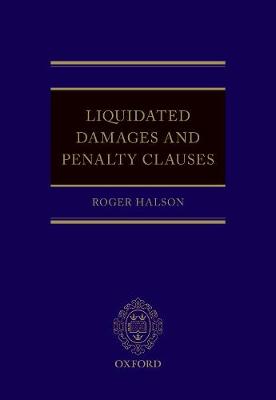
Title: Liquidated Damages and Penalty Clauses
Reviewed By:
Write your review here:
NOTE:HTML is not translated!
Rating:
Share this product on email
Liquidated Damages and Penalty Clauses
Product Details:
Format: Hardback
Publisher: Oxford University Press
Language: English
Dimensions: 25.00 X 2.00 X 18.00
Publisher Code: 9780198785132
Date Added: 2018-08-03
Search Category: International
Jurisdiction: International
Overview:
This, the only book in print to focus on liquidated damages and penalty clauses, analyses the common law jurisdiction to control stipulated damages clauses, and the distinction between enforceable liquidated damages clauses and unenforceable penalty clauses.
The first part examines the historical origin of the control of these clauses, the second describes the current control of such clauses and their legal effect, the third critically examines the various rationales that have been proposed to justify their regulation and the final part describes analogous provisions and how to avoid drafting contractual clauses that are rendered unenforceable by the penalty rule.
The book examines approaches in several common law jurisdictions in addition to England and Wales, including the United States, Australia, New Zealand, and Canada, and brings together principles developed in distinct commercial law contexts (such as shipping contracts) to enable comparison between particular contractual settings.
+ View More
Table Of Contents:
1: The Historical Origins of the 'Penalty' Rule
2: The Modern 'Penalty' Rule
3: The Legal Effect of Classification as a 'Penalty' or Valid Liquidated Damages Clause
4: The Rationale for the 'Penalty' Jurisdiction
5: Analogous Provisions and Avoidance Techniques
6: Specific Contracts and Contractual Provisions
Conclusion