Want a Shipping Estimate? Add an Indian Pin Code, Click Here
This Product
Ships in 3-4 Weeks
Recommend
1
Share
4
Share
2
Share
5
Share
5
Send By e-mail
Verify Phone Number
Please enter the One Time Password (OTP) to verify phone number.
Write your own review
In just a few steps below you can become an online reviewer.
Please click on Continue to submit your review.
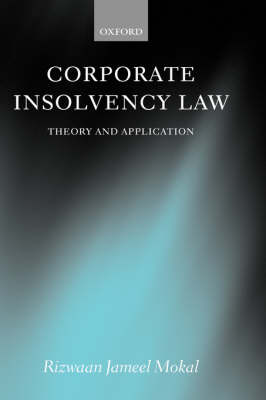
Title: Corporate Insolvency Law: Theory and Application
Reviewed By:
Write your review here:
NOTE:HTML is not translated!
Rating:
Share this product on email
Corporate Insolvency Law: Theory and Application
Product Details:
Format: Hardback
Publisher: Oxford University Press
Language: English
Dimensions: 24.00 X 3.00 X 17.00
Publisher Code: 9780199264872
Date Added: 2018-08-03
Search Category: International
Jurisdiction: International
Overview:
This volume analyses corporate insolvency law as a coherent whole, stemming from common fundamental principles and amenable to being justified or criticised on that basis. The author explains why consistency of principle must be sought and how it might be found in the relevant statutory and case law. He then constructs an egalitarian theory for the analysis of corporate insolvency law, based on the premise that all the parties affected by this law are to be treated
as equals. He argues that this theory can reconcile the dictates of fairness with the demands of economic efficiency.
The theory is employed to analyse some of the most important aspects of insolvency law. Why should the individualistic method of enforcing claims against solvent companies give way to a collective method during insolvency? Why are there different formal mechanisms for dealing with troubled companies? What role does the pari passu principle play in the distribution of an insolvent company s assets? The controversial issues of whether and when secured creditors should be accorded priority over
others receive detailed consideration. The functional role of the floating charge and its relationship with receivership are also analysed in this context. The many questions relating to the operation of the new administration procedure introduced by the Enterprise Act 2002 are considered in the light
of principle. The book also analyses the role of the wrongful trading provisions. It examines, finally, why insolvency law objects to certain transactions at an undervalue and those having a preferential effect.
This volume aims to enhance understanding of this important branch of the law, and to suggest principled solutions to problems which have not yet received judicial attention.
+ View More
Table Of Contents:
Preface ; 1. Introduction - Consistency of Principle in Corporate Insolvency ; 2. The Creditors' Bargain and the Collectivity of the Liquidation Regime ; 3. The Authentic Consent Model - Justifying the Collective Liquidation Regime ; 4. The Pari Passu Principle and its Relationship with Other Methods Of Insolvency Distribution ; 5. The Priority of Secured Credit ; 6. The Impact of Liquidation on Pre-Insolvency Transactions ; 7. 'Rescue' Regimes ; 8. The Position of Directors ; 9. Conclusion ; Selected Bibliography