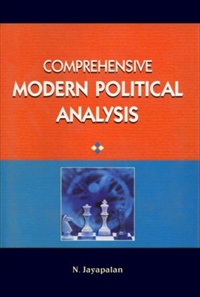
The book deals with all aspects of modern political analysis in detail. In this book the nature and scope of Politics is beautifully described in the first Chapter. In the following Chapters the main features of the study i.e., Behaviouralism, Group Theory, Game Theory, Political Culture and Political Socialisation have been discussed in a clear and lucid way. The Chapters on Political Participation and Political Evaluation have been presented in a pleasing manner so as to cater to the needs of the students of Politics and Public Administration. In the last Chapter, Theories of Social Change highlight the Political ideas of Mahatma Gandhi and Mao Tse-Tung in an excellent manner. Greater importance has been given in this Chapter to the methods of Gandhiji to achieve his ends in all fields for the welfare of the people.
Book Contents
1. Nature and Scope of Politics(i) Introduction; (ii) Nature and Scope; (iii) The Traditional View (Historical View); (iv) The Modern View; (v) Catlins View; (vi) Three Aspects of Political Theory; (vii) Criticism of Historical View; (viii) Assessment of Catlins View; (ix) Scope; (a) Value-Oriented Scope; (b) Focus-Oriented Scope; (x) Whether Political Science a Science or Philosophy?; (a) Meaning of Philosophy; (b) Meaning of Science; (c) Are both these Contradictory?; (d) Relationship between them Approaches to the Study of Political Science; (i) Historical or Traditional Approach; (ii) Sociological Approach; (iii) Philosophical; 2. Approach(iv) Integrated Approach; (v) Normative Approach; (vi) Empirical Approach (Empiricism); (vii) Institutional Approach; (viii) Autonomous Approach; (ix) Behavioural Approach; 3. Growth of Political Science(i) American Contribution; (ii) Makers of New Political Science; (iii) Impact of European Sociologists; 4. Inter-relationship of Politics and Other Social Sciences(i) Politics and History; (ii) Politics and Economics; (iii) Politics and Sociology; (iv) Politics and Ethics; (v) Politics and Psychology; (vi) Politics and Jurisprudence; (vii) Politics and Geography; (viii) Political Science and Public Administration; (ix) Politics and Anthropology; (x) Politics and Statistics; (xi) Political Science and Biology; 5. Need and Necessity of Political Theory(i) Definition of Political Theory; (ii) Recent Views about Political Theory; (iii) Nature of Modern Political Theory; (iv) Advantages of Political Theory; 6. Decline of Political Theory(i) Eastons Views; (ii) Cobbans Views; (iii) Germinos Ideas; (iv) Marxs Ideas; (v) Max Webers Ideas; (vi) Berlins Views; (vii) Behaviouralist View of Political Theory; (viii) Classical Approach to Political Theory; 7. Behaviouralism(i) The Origin; (ii) Development; (iii) Meaning of Behaviouralism; (iv) Characteristics of Behaviouralism; (v) Traditionalism Vs. Behaviouralism; (vi) Achievements of Behaviouralism; (vii) Limitations of Behaviouralists; (viii) Post-Behaviouralism; (ix) Credo of Relevance; (x) Trends and the Tendencies; (xi) Estimate; 8. General Systems Theory(i) Introduction; (ii) Origin and Growth; (iii) What is a system?; (iv) Systems Theory and General Systems Theory; (v) Basic Concepts of General Systems Theory; (vi) Impact on Political Analysis; (vii) Advantages of General Systems Theory; (viii) Limitations of the Theory; (ix) Estimate; 9. Input-Output Analysis(i) Introduction; (ii) Meaning; (iii) Input-Output Analysis of David Easton; 10. Structural and Functional Analysis(i) Structural-Functional Analysis of G. Almond; (ii) Functionalism Eclectic and Empirical; (iii) Structural Functional Framework Robert Merton; (iv) Marian J. Levy; 11. Distributive Analysis Harold D. Lasswell(i) Introduction; (ii) Works of Harold D. Lasswell; (iii) Origin; (iv) Basis for his Philosophy; (v) Types; (vi) Conceptual Framework and Structures; (vii) His Ideas about Elite; (viii) His Other Views; (a) Configurative Analysis; (b) Political Science; (c) Distributive Analysis; (d) Views on Individuals; (ix) Critical Evaluation of Lasswells Approach; (x) Decision-Making Process; (xi) His Analysis of Power; (xii) Developmental Analysis; (xiii) His Political Psychology; (xiv) His Positive Liberalism; (xv) Lasswell on Marxism; (xvi) His Views about International Understanding; (xvii) His Views about Propaganda; 12. Systems Theory Morton A. Kaplan(i) His Views about Systems Analysis; (ii) Criticism; 13. Arthur Bentleys Contribution to Group Theory(i) Group Approach; (ii) History of Group Approach; (iii) Significant Features of Group System; (iv) His Contribution to Group Theory; (v) Criticism; 14. Theory of Elites(i) Origin of the Theory; (ii) Elite Categories; (iii) Pluralist Views; (iv) Pareto about Political Elites; (v) Mosca about Political Elites; (vi) Michels about Political Elites; (vii) James Burnhams Views about Elite Group; (viii) Milovan Djilas Views about Elites; (ix) Theory of Managerial Revolution; (x) Intellectuals as Power Elite; (xi) Theory of the Masses Ortega Y. Gasset; (xii) Elite Theory and Democracy; (xiii) Elite Theory Fascism, Socialism and Marxism; (xiv) Role of Elites in Developing Countries; 15. Decision-making Approach(i) Introduction; (ii) Decision-making and its various aspects; (iii) Impact of Decision-making Approach; (iv) Estimate; 16. Game Theory(i) Introduction; (ii) Origin of the Theory; (iii) Characteristics of Game Theory; (iv) Types of Game Theory; (v) Application of Game Theory; (vi) The Kaplan Model Criticism; (vii) The Riker Model; (viii) The Schelling Model; (ix) Estimate; 17. Models and Simulations(i) Communications Theory and Cybernetics; (ii) Communications Theory Karl Deutsch Approach; (iii) Causes Responsible for the failure of Self-Governing System; (iv) Criticism; (v) Estimate; 18. Political Influence(i) What is influence?; (ii) Explicit Influence; (iii) Implicit Influence; (iv) Distribution of Political Influence; (v) Scope and Domain of Influence; (vi) Measurement for Influence; (vii) Differences in Political Influence; (viii) Political Influence and Prime Movers; (ix) Forms of Political Influence; (x) The Means of Influence; (xi) Estimate; 19. Power, Authority and Leadership(i) Introduction; (ii) Origin of the Concept of Power; (iii) Meaning of Power; (iv) Russells Views about Power; (v) Kinds of Power; (vi) Sources of Power; (vii) Views of Catlin, Lasswell and Kaplan; (viii) Characteristics of Power; (ix) Lump-of-Power Concept; (x) Power Theory of the State; (xi) Authority; (xii) Leadership; 20. Political Systems(i) Meaning of System Political System Characteristics; (ii) Properties of a Political System; (iii) Variables in a Political System; (iv) Similarities in Political Systems; (v) Differences in Political Systems; (vi) Distribution of Political Resources and Skills; 21. Political Culture; (i) Introduction; (ii) Origin of Political Culture; (iii) Culture and Political Culture Definition Meaning; (iv) Characteristics of Culture; (v) Classification (Typology); (vi) Political Culture; (vii) Civil Culture; (viii) Contribution of Political Culture Approach; (ix) Criticism; 22. Political Socialisation(i) Introduction; (ii) Definition Socialisation Political Socialisation; (iii) Elements of Socialisation; (iv) Agents of Political Socialisation; (v) Political Socialisation and Change; (vi) Political Socialisation and Social Systems; (vii) Criticism; 23. Theories of Alienation(i) Metaphysical Theory of Hegel; (ii) Socio-Economic Theory of Marx; (iii) Sociologists on Alienation; (iv) Critical Estimate; 24. Interests and Groups(i) Introduction; (ii) Kinds of Interest Groups; (iii) Interest Articulation; (iv) Channels and Means of Access; (v) Styles of Interest Articulation; (vi) Factors of Interest Articulation; 25. Conflict Legitimacy and Effectiveness(i) Political Conflict and Political Coercion; (ii) Conflict and Legitimacy; (iii) Typology of Legitimacy; (iv) Crises of Legitimacy and Social Change; (v) Legitimacy and Effectiveness; 26. Political Development Political Modernisation(i) Political Development; (a) Factors Favourable to Political Development; (b) Characteristics of Political Development; (c) Crises of Political Development; (ii) Political Modernisation; (a) Pyes Views; (b) Kenneth Organiskis Views; (c) David Apters Views; (d) Samuel Huntingtons Views; (e) F.W. Riggs Views; (iii) Models of Modernisation; (iv) Effects; (v) Perspective of Political Modernisation; (vi) Variables Affecting Political Modernisation; (vii) Political Modernisation and Development; (viii) Breakdowns of Modernisation; (ix) Consequences of Social Mobilisation; (x) Dilemmas of Modernisation; (xi) Purpose of Modernisation; (xii) Differences between Modernisation and Development; (xiii) Criticism; 27. Political Participation(i) Introduction; (ii) Meaning; (iii) Motivation of Political Participation; (iv) Political Participation in India; (v) Maladies in Indian Political Participation; (vi) Remedies; (vii) Participation in other Countries; (viii) Studies and Findings; 28. Political Evaluation(i) Introduction; (ii) Elements in Political Evaluation; (iii) Principal Appraisals; (iv) Empirical Analysis and Political Evaluation; (v) Different Approaches; 29. Contemporary Political Thought; (i) Jean Paul Sartre; (ii) Albert Camus; (iii) Karl Jaspers; (iv) Erich Fromm; (v) Robert S. Nisbet; (vi) The Newlook Movement; 30. Herbert Marcuse and His Political Philosophy; 31. Theories of Social Change M.K. Gandhi (1869-1948)(i) Introduction; (ii) His Early Life and Education; (iii) Gandhi in Action; (iv) Amritsar Tragedy; (v) His Role in Freedom Struggle; (a) Non-Co-operation Movement; (b) His Twentyone Day Fast; (c) Dandi March Civil Disobedience Movement; (d) Second Round Table Conference; (e) The Communal Award Fast unto Death; (f) The Cripps Mission; (g) League and its Demand; (h) The Partition; (vi) Martyrdom; (vii) Gandhian Thought; (a) Various Influences on Gandhian Thought and Philosophy. Western Influence on Gandhis thought and Philosophy; (b) Ideas on Religion and God; (c) Religion and Politics; (d) His Concept of Satyagraha and Non-violence Its Various Techniques Rules for Satyagraha; (e) His Views on Communism; (f) His Concept of Ideal State; (g) His Views on Village Republics; (h) His Economic Ideas; (i) His Social Ideas; (j) His Concept of Trusteeship; (k) Gokhale and Gandhi; (viii) Estimate; 32. Theories of Social Change Mao-Tse-Tung (1883-1976)(i) Introduction; (ii) Early Life; (iii) His Career; (iv) His Political Ideas; (a) His Views about Revolution; (b) His Ideas on Peasantry; (c) Opposition to Capitalism; (d) Stress on Villages; (e) His Views on Power, War, Neutral States, State, Personality Cult; (v) Cultural Revolution; (a) The Circumstances for the Revolution; (b) The Beginning of the Cultural Revolution; (c) Cultural Revolution in Progress; (d) The Significance of the Cultural Revolution; (vi) Marxism-Leninism; (vii) The Concept of Peoples War; (viii) Gandhi and Mao; (ix) Maos Achievements; (x) Estimate; Index


 Home > LAW BOOKS > Inactive > Society, Politics and Philosophy > Government and Politics > 1/1/2002


 5
5