Want a Shipping Estimate? Add an Indian Pin Code, Click Here
This Product
Ships in 3-4 Weeks
Recommend
1
Share
4
Share
2
Share
5
Share
5
Send By e-mail
Verify Phone Number
Please enter the One Time Password (OTP) to verify phone number.
Write your own review
In just a few steps below you can become an online reviewer.
Please click on Continue to submit your review.
Title: Statistics for Lawyers
Reviewed By:
Write your review here:
NOTE:HTML is not translated!
Rating:
Share this product on email
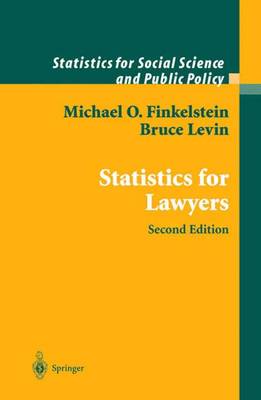
Statistics for Lawyers
Product Details:
Format: Hardback
Publisher: Springer-Verlag New York Inc.
Language: English
Dimensions: 23.00 X 3.00 X 16.00
Publisher Code: 9780387950075
Date Added: 2018-08-09
Search Category: International
Jurisdiction: International
Overview:
Designed to introduce law students, law teachers, practitioners, and judges to the basic ideas of mathematical probability and statistics as they have been applied in the law, the book consists of sections of exposition followed by real-world cases and case studies in which stastical data have played a role. Readers are asked to apply the theory to the facts, to calculate results (a pocket calculator is sufficient), and to explore legal issues raised by quantitative findings, while the author's own calculations and comments are given in the back of the book. The cases and case studies reflect a broad variety of legal subjects, including antidiscrimination, mass torts, taxation, school finance, identification evidence, preventive detention, handwriting disputes, voting, environmental protection, antitrust, and the death penalty. The first edition has been used in law, statistics, and social science courses, and in 1991 was selected by the University of Michigan Law Review as one of the important law books of the year. This second edition includes many new problems reflecting current developments in the law, including a new chapter on epidemiology.
+ View More
Table Of Contents:
Describing Data.- Inferring Causation.- How to Count: Permutations and Combinations.- Elements of Probability.- Some Probability Distributions.- Statistical Inference for Two Proportions.- Comparing Multiple Proportions.- Comparing Means.- Combining Evidence Across Independent Strata.- Sampling Issues.- Survival Analysis.- Nonparametric Methods.- Regression Models.