Want a Shipping Estimate? Add an Indian Pin Code, Click Here
This Product is
Sold Out
Free Delivery With
Recommend
5
Share
1
Share
1
Share
0
Share
1
Send By e-mail
Verify Phone Number
Please enter the One Time Password (OTP) to verify phone number.
Write your own review
In just a few steps below you can become an online reviewer.
Please click on Continue to submit your review.
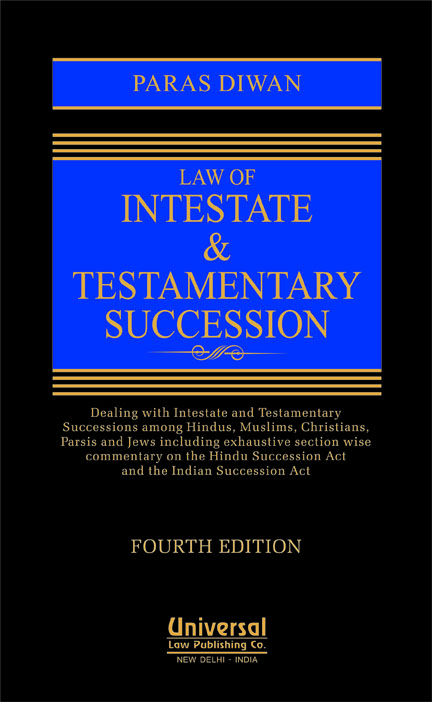
Title: Law of Intestate and Testamentary Succession
Reviewed By:
Write your review here:
NOTE:HTML is not translated!
Rating:
Share this product on email
Law of Intestate and Testamentary Succession
Product Details:
Date Added: 2017-01-01
Search Category: Lawbooks
Jurisdiction: Indian
Overview:
We are happy to present the revised edition of the work. As prophet Mohammed said ``learn the laws of succession and teach them to people, for they are onehalf of the useful knowledge.`` This work has made an endeavour to make available this ``one half of useful knowledge.`` both intestate and testamentary among all major communities of India, viz., Hindus, Muslims, Christians and Parsis in a language and style which brings this knowledge in comprehension of even a lay person.The Law of succession is essentially an offshoot of the concept of private property. The societies having the concept of communal ownership of property did not have the Law of Succession. In such societies property belongs to all the members of the community. When a member of such community dies, he leaves behind no property and, therefore, question of succession does not arise, Whereas in societies adhering to concept of private property, the property must be owned by someone. The owner may be an individual or a corporation or state. Property cannot remain ownerless even for a moment and therefore on the death of its owner it must immediately vest in someone. Thus, the question as to who would be the owner of property after death, is answered by Law of Succession.The law grants freedom to an individual to bequeath his property (though under Muslim law it is to the extent of onethird) to any person whether a relation or stranger or institution by executing a will. Such person can also lay down the scheme of distribution of property. This branch of Law of Succession is called Testamentary Succession.The Hindu Law of Succession had undergone some major changes by virtue of Hindu Succession (Amendment) Act, 25. The erstwhile section 6 has been completely modified and new section has been incorporated. The major change that has been brought by it is that daughters have been made coparcencers along with sons in the joint family.The purport of amendment was to bring about parity between sons and daughters. Theis section has come up for interpretation in many courts of the country including the apex court. The courts have upheld the objective of the amendment and given liberal interpretation to the provision.